

According to the Australian Association of National Advertisers (AANA) Code of Ethics which came into effect from January 2012, if an advertisement includes imagery and language that result in negative impression of a certain group, namely race, ethnicity, rationality, gender, age, sexual preference, religion and political belief, it will be found in breach of Section 2.1 and hence be requested to be removed. The types of behaviors under restricted depictions are “discrimination – unfair or less favorable treatment” and “vilification – humiliates, intimidates, incites hatred, contempt or ridicule”.
Clearly, there has been a long history of racism in advertising industry. In the 1880s, what The Bulletin published would never satisfy this code. Under the masthead ‘Australia for the white man’, the magazine printed content which would be controversial now, including racist cartoons, sexist articles, criticism of Britain and other foreign nations, attacks on conservative governments.


Before it was termed as racism, stereotyping had been a technique which brands used to identify with a targeted group of consumers. It is believed that by representing characters that share common desires and traits with consumers, they would have a favorable feeling towards the product and therefore, purchase it. Ads such as The Nulla-Nulla soap advertisement in 1920s is an extreme version of racial stereotyping which would breach the AANA Code of Ethics nowadays.

While this example from a hundred years ago is extreme, it is noteworthy that the subtle line between relevance and offensiveness is still an issue in 2019. Due to different background, experience, and knowledge, people will decode a message differently from the intention. Among which, outrage and backlash can be one of the reactions.
More specifically, racism in advertising is often categorized into one of the two popular forms: archetypal representation of certain races and under-representation of minorities in advertisements.
Firstly, stereotype is a conviction that different groups of race, religion, sexual predilection or gender have certain responsibilities, traits, and positions in society. This often conveys an oversimplified impression of a group of people, which results in image degradation.
Take Nivea’s skincare print ad in 2001 for example. The ad provoked public outrage and caused the brand to pull it for highlighting a well-groomed black model hurling the “decapitated head of another black man with an afro and beard”.

Audience expressed their anger at the inappropriate tagline “Re-civilize yourself” implying Black Culture as uncouth, a convention of Black Community that has had a pervading history. As stated in AANA Code of Ethics, Nivea’s tagline would breach the code for discriminating a group of ethnicity.
Following is one of the responses from audience.
“The message here is clear: If you’re black, embracing a tonsorial style that isn’t close cropped and clean-shaven will make you look like a total beast and no one will ever trust or hire you. You’d better run to CVS and get some Nivea products before your chance for a good life washes down the drain! Offensive? Absofuckinglutely. True? Not at all.”
Styleite’s Justine Fenner
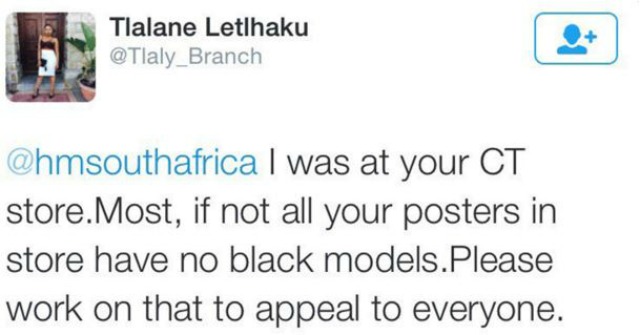
Furthermore, omission of representatives from targeted demographic is another reason for public backlash. H&M, a renowned fashion retailer, in 2015 has been caught up in a drama due to Twitter exchange with a consumer about their ad campaign in South Africa.
In their response, H&M explained that “We want our marketing to show our fashion in an aspiring way, to convey a positive feeling”.
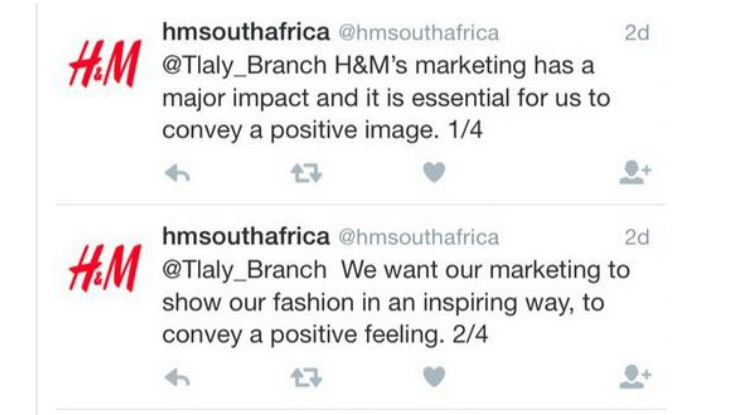
It is reported in an article that certain things which stood out from the reply had led to numerous outrageous tweets, questioning the implication that black models would make the brand compromise their essence.
Can both Nivea and H&M be regarded as racist?
Nivea is discriminatory because of their appeal to the nature of Black culture stereotype. Meanwhile, H&M is racist because they failed to show the diversity of society in a country which is 90% Black. If they were Australian advertisements, they would be both liable to AANA Code of Ethics. It would be possible for consumers to submit letter of complaints to AANA committee and request that the advertisements are abolished.
Since the goal of advertisements is to be relevant to a specific demographic, racial tropes are commonly adopted. Though they are not intrinsically adverse, whether it is ethical to employ stereotypes in advertisement has been the subject of much debate.
To begin with, it happens because of the use of caricatures in advertising that rely on truth or perception to illustrate ideas in a short measure of time. The length of a commercial is often restricted to thirty-second, hence, there is no space to draw a backstory.
Quick-fire caricatures are served to bridge the knowledge gap using presumed meanings of a character or situation.
Eisend, Plagemann, and Sollwedel
Consumers with little to no information can get a grasp of a simplified context and consequently, proceed their purchase.
Secondly, a lack of executives and senior leaders from minorities in advertising limits the objectivity and cultural sensitivity when making connections with different groups of consumers. In a survey by AdNews and Magic Beans, it shows that only 10% of respondents from advertising agencies were from non-white countries. Meanwhile, the 2018 – 2019 Hays Diversity & Inclusion Report displays that executives and senior leaders from Black, Asian and Minority Ethnic (BAME) backgrounds account for just 3% in Australia workforce, which means candidates who are of BAME descent in advertising is far uncommon.
Thirdly, the issue of diversity also occurs in client decision-making in appointing brand representatives. Marketers are inclined to partner with white voices for fear that target audience can not relate to someone from another ethnicity.
How can non-racist ads be encouraged to thrive?
From media perspective, practitioners can utilise a message-centered approach to challenge racial stereotypes rather than forcing the ads to look like an ethnicity. In fact, brands should focus on how to get the messages across the diverse groups of audience.
On the other hand, consumers and audience should be critical of the information they receive from media instead of believing in everything being said. It is important that consumers know about uni-dimensional racial portrayals in media to avoid being influenced by those narrow self-versions.
It is too soon to conclude but non-racist advertisements are possible to happen with efforts and determination. Although there has been a history of racial stereotyping in advertising industry, brands should realise that there are better ways to target a market. The ‘Thank You, Mom‘ advertisement by P&G is a great example because it concentrates on promoting why the products help mothers take care of their children while reflecting diversity of people.
 Helly Pham